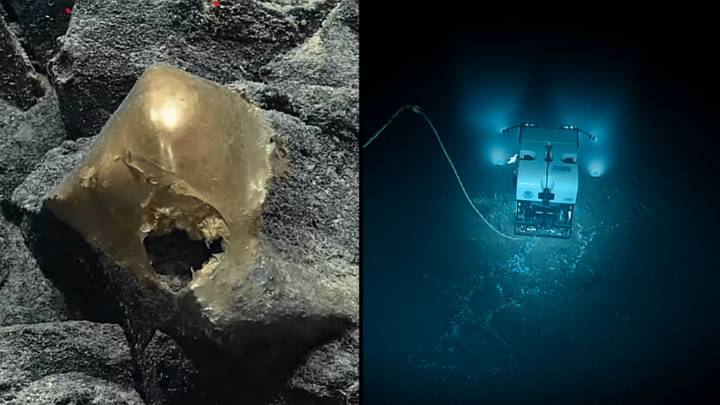
In the inky black of the Bering Sea, 3,000 feet below the surface, a remotely operated vehicle (ROV) captured footage of something no scientist had ever seen: a perfect, glowing golden orb, suspended in the water like a lost relic from another world. The discovery sent shockwaves through the scientific community and the public alike. Social media lit up. “What the heck is that?” became a global refrain. For weeks, speculation ran wild—was it alien? A deep-sea weapon? A new species? The truth, when it came, was almost stranger than fiction.
Now, after extensive analysis, researchers have cracked the mystery. The golden orb wasn’t alien tech or a secret government experiment. It was a biological marvel—one of nature’s most intricate reproductive strategies, wrapped in mystery and shimmering gold.
The Discovery: A Moment That Stopped Ocean Scientists
The golden orb was first spotted in 2023 during a NOAA Ocean Exploration mission mapping the deep ocean floor off the coast of Alaska. The ROV, sent to study seafloor geology and biodiversity, drifted over a rocky outcrop when the camera caught a flash of gold in the darkness.
At first, the team thought it was mineral—perhaps a sulfur deposit or a rare nodule reflecting the ROV’s lights. But as they moved closer, the shape was unmistakable: spherical, smooth, and about the size of a grapefruit. It hung motionless, tethered slightly to the rock, glowing faintly in the artificial light.
“What is that?” a voice can be heard asking on the live feed. “It looks… manufactured.”
The clip went viral within hours. Viewers compared it to a sci-fi artifact, a submerged egg from a mythical beast, even a deep-sea surveillance device. But for marine biologists, the mystery presented a rare opportunity.
First Reactions: Confusion, Wonder, and Wild Theories
The immediate reaction from experts was cautious confusion. “We’ve seen a lot down there,” said Dr. Janet Voight, a deep-sea biologist at the Field Museum, “but I’ve never seen anything like that. It’s not a sponge, not a coral, and definitely not a rock.”
Online, theories exploded:
- Alien origin: Some pointed to its symmetry and color as evidence of non-terrestrial design.
- Military device: Conspiracy threads claimed it was a lost sonar reflector or drone component.
- Unknown species: The most plausible, yet still baffling, idea—this was something entirely new to science.
But deep-sea researchers knew better than to jump to conclusions. In the ocean’s depths, appearance can be deceiving. What looks artificial is often the most evolved natural design on Earth.
Breaking the Case: How Scientists Identified the Orb
NOAA didn’t stop at the footage. They returned to the site multiple times, using the ROV to collect a sample. Preserving deep-sea specimens is notoriously difficult—pressure changes, temperature shifts, and biological degradation can destroy delicate structures before they reach the surface.
But this time, the team succeeded.

Back in the lab, scientists conducted CT scans, DNA analysis, and microscopic examination. The outer layer, golden and gelatinous, was a thick, protective capsule—highly resistant to pressure and microbial attack. Inside, instead of machinery or alien tissue, they found thousands of tiny, spherical structures.
These were eggs.
More specifically, the golden orb was a giant egg mass produced by a deep-sea sea slug—likely a species of Pleurobranchaea, a genus known for laying clustered egg sacs. But nothing like this had ever been documented before. Most sea slug egg masses are small, translucent, and ribbon-like. This one was spherical, brilliant gold, and nearly 10 inches in diameter.
Why Gold? The Evolutionary Genius Behind the Color
The color wasn’t just coincidental—it was strategic.
Marine biologists believe the golden hue acts as a natural deterrent. In the deep sea, where light is nearly absent, color usually doesn’t matter. But many deep-sea predators use bioluminescence to hunt. When they shine their own light on prey, bright or reflective surfaces can signal danger or unpalatability.
Think of it like aposematism in land animals—the way a poison dart frog’s bright colors warn predators: Don’t eat me, I’m toxic.
In this case, the golden sheen may mimic inedible or toxic objects, helping the egg mass survive in a world full of hungry snails, crabs, and fish. The thick, gelatinous coating also likely contains chemical defenses, making it unappealing or even harmful to consume.
“It’s like nature’s version of a stealth vault,” said one researcher. “Looks too strange to eat, too tough to break open.”
Rare But Not Unique: Other Bizarre Deep-Sea Reproductive Strategies
While this golden orb is the first of its kind discovered, it’s part of a broader pattern of evolutionary innovation in the deep ocean.
Consider:
- Paper nautilus egg cases: Female argonauts create delicate, spiral shells solely to hold eggs—structures so elegant they were once mistaken for actual shells.
- Glowing shark egg cases: Some deep-sea catsharks lay eggs that emit faint light, possibly to communicate with developing embryos or repel predators.
- Communal coral spawning: Entire reefs release egg-sperm bundles in synchronized events, creating underwater “snowstorms” of reproduction.
The golden orb fits right in. It’s an extreme adaptation to an extreme environment. With mating opportunities rare in the deep sea, reproduction has to be efficient, protected, and long-lasting. A single, robust egg mass increases the odds that at least some offspring survive.
Why This Discovery Matters Beyond Curiosity
Yes, the golden orb is fascinating. But its real value lies in what it reveals about deep-sea ecosystems—and how little we still know.
- Biodiversity mapping: Every new species or behavior helps scientists understand the complexity of deep-ocean life.
- Conservation urgency: As deep-sea mining expands, discoveries like this underscore how much is at risk before we even document it.
- Biological inspiration: The orb’s protective coating could inspire new materials—self-sealing gels, pressure-resistant containers, or even bio-armor.
“We’re not just finding curiosities,” said a NOAA scientist. “We’re discovering blueprints—evolution’s solutions to problems we’re still trying to solve.”
Common Misconceptions About Deep-Sea Discoveries

The golden orb incident also exposed how public perception of ocean exploration often misses the mark.
Myth 1: “If we haven’t seen it, it must be new.” Reality: Many deep-sea organisms have existed for millions of years. We’re just now reaching their habitats with advanced tech.
Myth 2: “Everything down there is dangerous or alien.” Reality: Most deep-sea creatures are fragile, slow-moving, and adapted to scarcity—not monsters.
Myth 3: “Scientists should know what everything is.” Reality: Less than 25% of ocean species are documented. New discoveries are routine.
The golden orb wasn’t an anomaly. It was a reminder: the ocean is still the last true frontier.
What’s Next? The Future of Deep-Sea Exploration
The resolution of the golden orb mystery doesn’t close the book—it opens a new chapter.
NOAA and other institutions are planning more missions to Alaska’s deep slopes, now with specific targets: egg masses, reproductive behaviors, and previously unseen invertebrates. Autonomous underwater vehicles (AUVs) with AI-powered recognition software are being deployed to flag unusual structures in real time.
And the public is more engaged than ever. Live feeds from ROVs now draw thousands of viewers—citizen scientists who’ve spotted new species in background footage.
The golden orb, once a symbol of mystery, has become a symbol of discovery.
Final Thoughts: Nature’s Greatest Mysteries Are Still in the Deep
The golden orb found off Alaska wasn’t a weapon, an alien probe, or a hoax. It was a mother’s investment in the future—packaged in gold, hidden in darkness, and protected by millions of years of evolution.
Its discovery reminds us that wonder doesn’t require fantasy. The real world, especially the deep ocean, is strange enough.
So the next time you hear “What the heck is that?”, don’t reach for sci-fi explanations. Look to science. The answer might be even more incredible.
What was the golden orb found in the ocean off Alaska? It was a giant egg mass laid by a deep-sea sea slug, likely a species of Pleurobranchaea, discovered at a depth of around 3,000 feet.
Why was the orb golden in color? The golden hue is believed to act as a visual deterrent to predators in bioluminescent environments, signaling that the mass may be toxic or inedible.
Could the golden orb be from an alien species? No. Despite early speculation, scientific analysis confirmed it was entirely biological and consistent with known deep-sea reproductive strategies.
How did scientists identify the golden orb? Through CT scanning, DNA testing, and microscopic analysis of the collected specimen, researchers identified thousands of developing embryos inside.
Are there other creatures that lay similar egg masses? While many sea slugs lay egg masses, none have been documented in this spherical, golden form—making it a unique discovery.
Was the creature that laid the orb ever found? Not yet. The adult sea slug remains undiscovered, likely due to its elusive nature and the difficulty of deep-sea observation.
What does this discovery mean for ocean conservation? It highlights how little we know about deep-sea ecosystems and underscores the need to protect these areas from industrial threats like mining and trawling.
FAQ
What should you look for in Golden Orb Found in Ocean Off Alaska – Solved at Last? Focus on relevance, practical value, and how well the solution matches real user intent.
Is Golden Orb Found in Ocean Off Alaska – Solved at Last suitable for beginners? That depends on the workflow, but a clear step-by-step approach usually makes it easier to start.
How do you compare options around Golden Orb Found in Ocean Off Alaska – Solved at Last? Compare features, trust signals, limitations, pricing, and ease of implementation.
What mistakes should you avoid? Avoid generic choices, weak validation, and decisions based only on marketing claims.
What is the next best step? Shortlist the most relevant options, validate them quickly, and refine from real-world results.